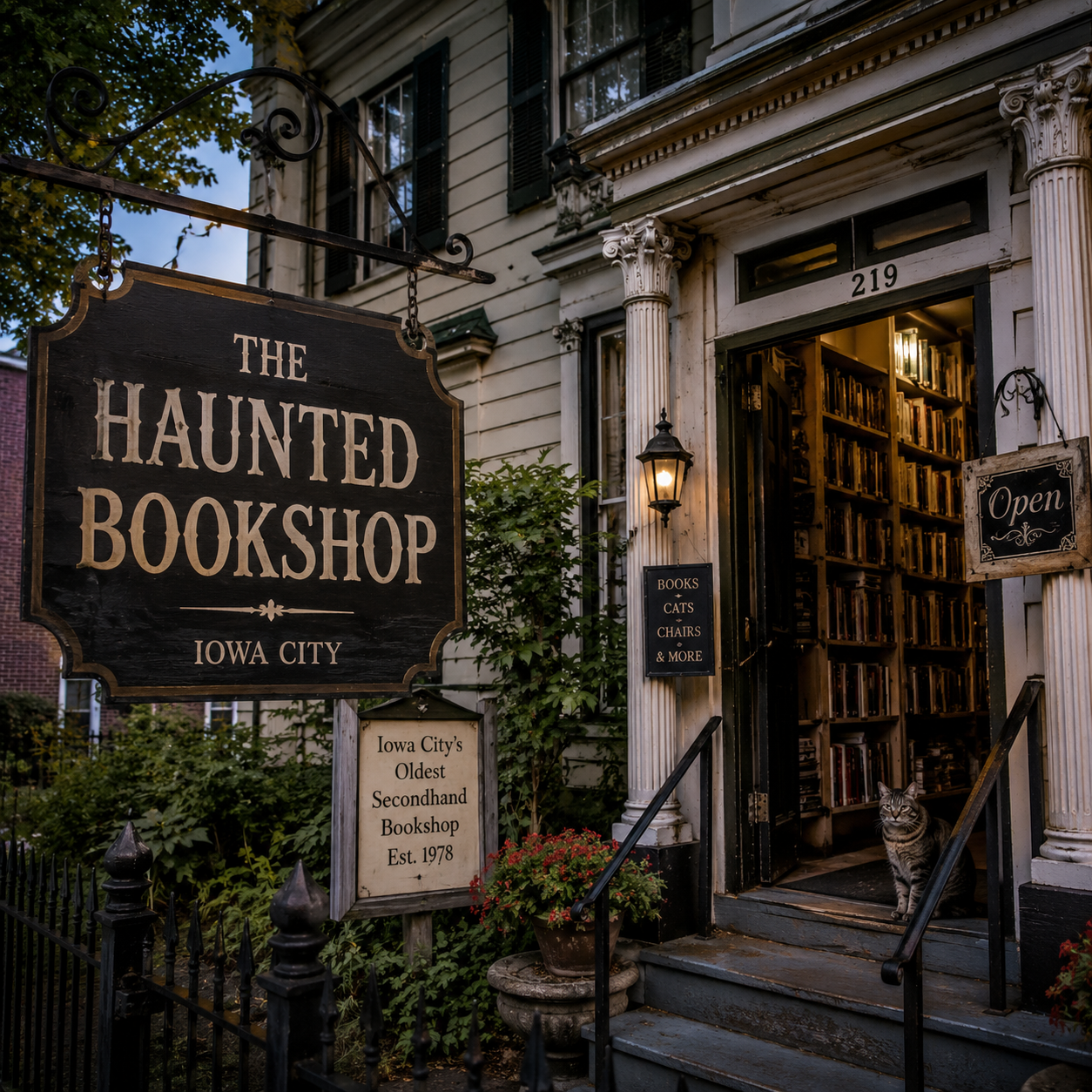
In Iowa City, a town already known for writers, readers, and the University of Iowa’s literary life, one secondhand bookstore has managed to stand out with a name that sounds as if it came from a novel: The Haunted Bookshop.
The name is memorable, but the store is not a gimmick.
The Haunted Bookshop is Iowa City’s oldest secondhand bookshop. It carries tens of thousands of used, rare, out-of-print, and antiquarian books across dozens of subject areas, from poetry and fiction to history, philosophy, children’s books, art, science, religion, Iowa-related books, and more. It is the kind of shop where readers come to browse, collectors come to search, and regulars come because the place has become part of their routine.
The bookstore opened in 1978. According to a Downtown Iowa City historical note, the original founders were Rok and Jan Williams, and the shop first operated out of their residential home. Many of the best secondhand bookstores did not begin as polished retail concepts. They grew from personal collections, private obsessions, reader habits, and the willingness to let books take over more space than originally planned.
Today, The Haunted Bookshop is located at 219 North Gilbert Street, in the Jacob Wentz House. The address alone gives the store part of its character. The Wentz House was built in 1847 and is listed on the National Register of Historic Places. It is one of Iowa City’s notable surviving examples of Greek Revival architecture, a style once more common in the area. The building was originally a residence and later served other uses before becoming home to the bookstore.
For a secondhand bookshop, the building works almost too well. Rooms replace aisles. Doorways lead into sections. A visitor moves through the store more like a house than a retail floor. That arrangement changes the experience of browsing. Instead of seeing the inventory all at once, a customer discovers it room by room.
The store’s own description says it carries more than 40,000 used, rare, out-of-print, and antiquarian titles in more than 50 subject areas. Its social media description has put the number closer to 45,000 books in more than 70 sections. Either way, the point is clear: this is not a small novelty shop with a spooky name. It is a serious used bookstore with substantial stock and a long local history.
There are also cats.
A detail that may sound minor, but in the life of a neighborhood bookshop, it is not. The Haunted Bookshop has become known not only for books, but for its resident cats, chairs, and room-by-room browsing. In 2018, when Little Village marked the shop’s 40th anniversary, the article noted the store’s connection with readers and cats, and also reported that the shop raised thousands of dollars each year for Iowa City’s Free Medical Clinic through proceeds from low-priced books near the back door.
Part of the story which deserves attention. A good local bookstore does not only sell books. It participates in the life around it. The Haunted Bookshop has done that quietly, through used books, donations, neighborhood presence, and the daily work of staying open in a world where independent bookstores have had to adapt again and again.
The haunted part is more complicated.
The name comes from Christopher Morley’s 1919 novel The Haunted Bookshop, a biblio mystery about a bookseller and mysterious events surrounding a particular book. Morley’s fictional bookstore was not a supernatural place in the simple ghost-story sense. The title played with the idea that a bookstore can be haunted by books themselves, by ideas, authors, memory, and old stories.
This literary origin gives the Iowa City shop a more interesting name than a simple ghost claim. It suggests not a haunted attraction, but a bookstore built in conversation with book culture itself.
Still, the current shop leans into the idea with some playfulness. Public descriptions refer to its “ghost,” and the store has rooms named after patrons, cats, and even one of the shop’s ghosts. Visitors sometimes mention the old-house atmosphere. But from available public information, the strongest documented facts are not about paranormal proof. They are about longevity, inventory, architecture, and community.
Making The Haunted Bookshop more compelling.
A lesser story would depend entirely on whether a ghost is real. This one does not. The store has the right kind of name, the right kind of building, the right kind of city, and the right kind of history. It stands in a literary town, inside a house built before the Civil War, holding thousands of books that have passed through other hands. That is enough to make the place memorable without stretching the truth.
The Haunted Bookshop belongs in the category of storied bookshops because it shows how a bookstore can be more than a business. It can become a destination, a local habit, a historic building in use, a rescue point for old books, and a place where the ordinary act of browsing becomes slower and more deliberate.
Many people buy books by typing a title into a search box, The Haunted Bookshop offers a different kind of encounter. A person has to enter, move through rooms, scan spines, pick up titles, and make discoveries without an algorithm deciding what should come next.
That may be the real importance of a store like this.
it isn’t haunted in the dramatic sense, but it keeps alive a form of reading culture that depends on chance, patience, memory, and place. The name may bring people in. The books, the building, and the experience give them a reason to stay.
Leave a Reply